Lower Back Exercises – Simple Ways to Improve Strength and Support Your Back
Lower back exercises – If you’re searching for these, you’re not alone—low back pain is a common reason people cut back on activity, avoid exercise, or feel less confident in day-to-day movement.
The encouraging part: for many people with non-specific low back pain (pain not caused by fracture, infection, cancer, inflammatory disease, or severe nerve compression), a well-chosen plan of movement + strengthening + mobility work can reduce pain and improve function. Large evidence syntheses of randomized trials consistently show that exercise improves pain and disability compared with minimal care. For example, a 2026 systematic review and meta-analysis of 35 RCTs (n=2,132) found a significant overall pain benefit of exercise interventions (SMD −0.81, 95% CI −0.91 to −0.72; p<0.001) in chronic non-specific low back pain.
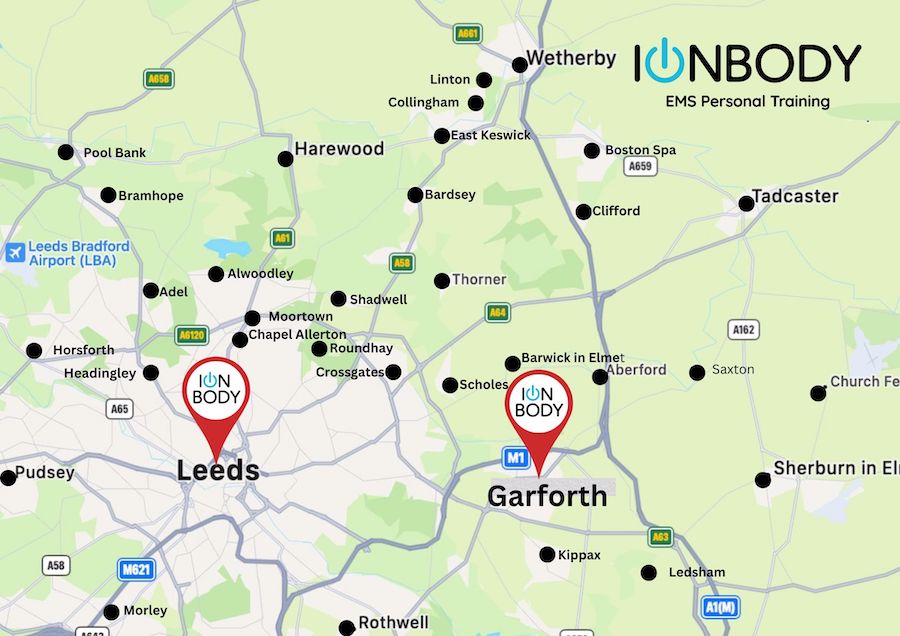
At ION BODY, we work with people in Garforth (LS25), Leeds (LS1), and nearby areas who want safe, structured ways to build strength, move better, and feel more confident again.
Lower Back Exercises – Safety first: when to get checked before exercising
Seek medical assessment urgently if back pain is accompanied by red flags (e.g., new bowel/bladder dysfunction, saddle anesthesia, progressive leg weakness, fever, unexplained weight loss, history of cancer, significant trauma). (General clinical safety principle; not covered by the supplied sources.)
Lower Back Exercises – Why lower back strength (and hip strength) matters
Your lower back doesn’t work in isolation. Daily tasks—standing, lifting, walking, training—depend on coordinated support from the core/trunk, glutes/hips, and surrounding muscles. When those systems are under-trained, sensitive, or deconditioned, stiffness and discomfort can increase.
Evidence supports trunk-focused/core-based exercise programmes for chronic non-specific low back pain. A 2023 Journal of Orthopaedic & Sports Physical Therapy systematic review of 40 RCTs (n=2,391) found trunk-focused exercise programs improved pain and disability versus controls, and showed small but measurable advantages over general exercise for pain and disability (SMD 0.20 for both outcomes).
Simple lower back exercises (with evidence-informed choices)
1) Walking (easy, accessible, reproducible)
Walking is one of the most practical starting points: it keeps you moving, can reduce stiffness, and is easy to progress gradually. In the 2026 meta-analysis (35 RCTs), walking showed significant improvements in pain and disability; walking trials also showed particularly consistent results (very low heterogeneity reported for pain in that subgroup).
How to start (practical): begin with a comfortable duration and pace and build gradually (e.g., add a few minutes every few days as tolerated). (Practical guidance; not a numeric claim.)
2) Core stability / motor control exercises (e.g., bird dog)
Core-based and stabilization-style exercise is repeatedly supported in chronic low back pain evidence. A 2019 BJSM network meta-analysis of 89 trials (n=5,578) found stabilisation/motor control and resistance training ranked among the most effective for physical function compared with true control.
For short, symptom-modulating effects, a 2025 European Journal of Pain study found 10 minutes of core stabilisation produced local exercise-induced hypoalgesia in chronic non-specific low back pain (mechanistic/physiology-oriented relevance rather than long-term outcomes).
3) Glute bridges (hip strength to support the back)
Glute bridges are commonly used within trunk/hip stabilisation programmes (and appear within exercise therapy protocols in chronic LBP trials and summaries). In comparative evidence, supervised exercise therapy including core strengthening and related movements is beneficial, and exercise therapy overall compares favorably with minimal care in many reviews.
4) Pilates, strength training, and “core-based” programmes (often top-ranked)
If you want a more structured approach, Pilates and strength-focused programmes have strong evidence signals in chronic non-specific low back pain:
A 2022 JOSPT network meta-analysis of 118 trials (n=9,710) found Pilates had the highest likelihood of improving both pain (SUCRA 93%) and disability (SUCRA 98%), and that most exercise types improved pain/disability versus control except stretching for pain and McKenzie for disability in that synthesis.
A 2019 BJSM network meta-analysis similarly found Pilates ranked best for pain (SUCRA 100%, pooled SMD −1.86, 95% CI −2.54 to −1.19) in chronic non-specific low back pain.
5) Stretching (useful as an add-on, less reliable as a stand-alone for pain)
Mobility work can help you feel looser and may support better movement quality, but stretching alone is less consistently effective for pain relief in some syntheses. In the 2022 JOSPT network meta-analysis, stretching did not show benefit for reducing pain compared with control.
Lower Back Exercises – The importance of strength training (and staying active)
Many people assume rest is the solution when their back hurts. Short rest may be appropriate in a flare, but long-term inactivity can reduce capacity and confidence.
Across higher-level evidence (umbrella reviews and network meta-analyses), exercise therapy—including strengthening and core-based approaches—generally improves pain and disability compared with minimal interventions, though certainty varies from low to moderate depending on the comparison and outcome.
Lower Back Exercises – Exercise should be personal (and progressed)
There is no single “perfect” lower back exercise for everyone. The most effective plan is one that matches:
your symptoms and current tolerance,
your daily demands (sitting job vs physical work),
your goals (pain reduction, lifting confidence, fitness),
and your ability to stay consistent.
A key takeaway from the evidence is not just what you do, but doing it regularly and progressively in a way you can sustain. Exercise trials vary widely in session frequency and programme duration, reflecting that multiple workable routes exist when individualised appropriately.
Lower back support in Garforth and Leeds
If you’re looking for lower back exercises, strength training, or help improving movement confidence in Garforth (LS25), Leeds (LS1), or nearby areas, a structured strength and conditioning programme can help you progress safely—especially if you’re unsure what to do or you’ve been stuck in a cycle of flare-ups.
References
Liu X, et al. Frontiers in Physiology (2026). Effects of different exercise interventions on lower back pain: systematic review and meta-analysis.
Comachio J, et al. Journal of Sport and Health Science (2025). Benefits and harms of exercise therapy and physical activity for low back pain: umbrella review.
Fernández-Rodríguez R, et al. Journal of Orthopaedic & Sports Physical Therapy(2022). Network meta-analysis of best exercise options for chronic low back pain.
Owen PJ, et al. British Journal of Sports Medicine (2019). Network meta-analysis of exercise training modes for chronic low back pain.
Prat-Luri A, et al. Journal of Orthopaedic & Sports Physical Therapy (2023). Trunk-focused exercises systematic review with meta-analyses.
González-Gómez L, et al. European Journal of Pain (2025). Exercise therapy versus manual therapy systematic review with meta-analysis.
Tomschi F, et al. European Journal of Pain (2025). Ten minutes of core stabilisation exercise and local hypoalgesia in chronic non-specific low back pain.
find us at
PHONE NUMBER
07512 769315
LOCATION 1
EMS 1-to-1, 2-to-1, Ice Bath & Group Exercise
Garforth Leeds Studio:
7 Long Meadowgate,
Leeds,
LS25 2BX
LOCATION 2
EMS 1-to-1
Leeds Centre Studio:
12 Park Place,
Leeds,
LS1 2RU